
AkshaERP · Circulation
Circulation Management
Manage recurring publication distribution from Agent demand and subscriber entitlement through daily Print Orders, dispatch, billing, collections and financial reconciliation.
THE OPERATING CHAIN
Operational events stay connected to the financial result they create.
AkshaERP supports
AkshaERP Circulation supports recurring newspaper and periodical distribution from Edition and Agent setup through daily supply, billing, collections, adjustments, ledger visibility and Agent settlement.
- Edition Centers, geography, Agents and Dispatch Routes
- Effective-dated Paid and Free Agent Indents
- Subscription Plans, subscribers and Active Subscriptions
- Daily Print Orders with Paid / Free / Subscription separation
- Agent billing, Receipts, Deposits, Credit Notes and Debit Notes
- Agent Accounts, Opening Balances and Circulation Ledger statements
- Agent Exit and controlled settlement
START HERE
Choose the path that matches your work
Circulation is easier to learn when implementation, daily operations and finance are treated as different operating journeys.
Configure Edition Centers, geography, Products, Agents, routes, Accounts and subscription foundations.
Start implementation →Daily operatorRun daily circulationMaintain effective supply, generate the daily Print Order, review quantities and approve the operational basis.
Open daily workflow →Billing teamRun periodic billingGenerate Bills from approved chargeable supply, review Drafts, Confirm & Post, then print or distribute Bills.
Open billing guide →Collections teamCollect and reconcileRecord payments, subscriptions and adjustments, then trace financial effects through Accounts and Ledgers.
Open collection guide →TASK FINDER
What do you want to do?
Jump directly to the guide for the business task instead of searching by screen name.
OPERATING RHYTHM
Know what happens once, daily and periodically
Implementation foundation
- Edition Centers and geography
- Products and pricing context
- Agents and Dispatch Routes
- Accounts and Opening Balances
- Subscription Plans and Customers
Supply and dispatch control
- Maintain effective Indents
- Generate Print Order
- Review Paid / Free / Subscription
- Confirm and Approve
- Print / dispatch / investigate Agent supply
Billing and reconciliation
- Verify daily completeness
- Generate Bills
- Confirm & Post
- Collect Receipts
- Post adjustments when required
- Reconcile Accounts and Ledgers
CORE WORKFLOWS
Two workflows control most recurring Circulation activity
WORKFLOW
Daily circulation
Create one protected daily supply basis from effective Agent demand and subscriber entitlement.
WORKFLOW
Periodic billing
Convert approved chargeable supply into controlled financial dues, collection and reconciliation.
FUNCTIONS
Explore Circulation by business responsibility
Foundation
Define the operating and financial structure once.
Agent network
Model the distribution network and governed financial identity.
Supply & subscriptions
Maintain recurring Agent demand and subscriber entitlement.
Daily operations
Create and control the approved daily physical supply basis.
Billing & collections
Convert approved supply into dues and collections.
END-TO-END MAP
See how the full process connects
The detailed process map keeps Agent supply, subscriber entitlement, billing and financial history in one view.
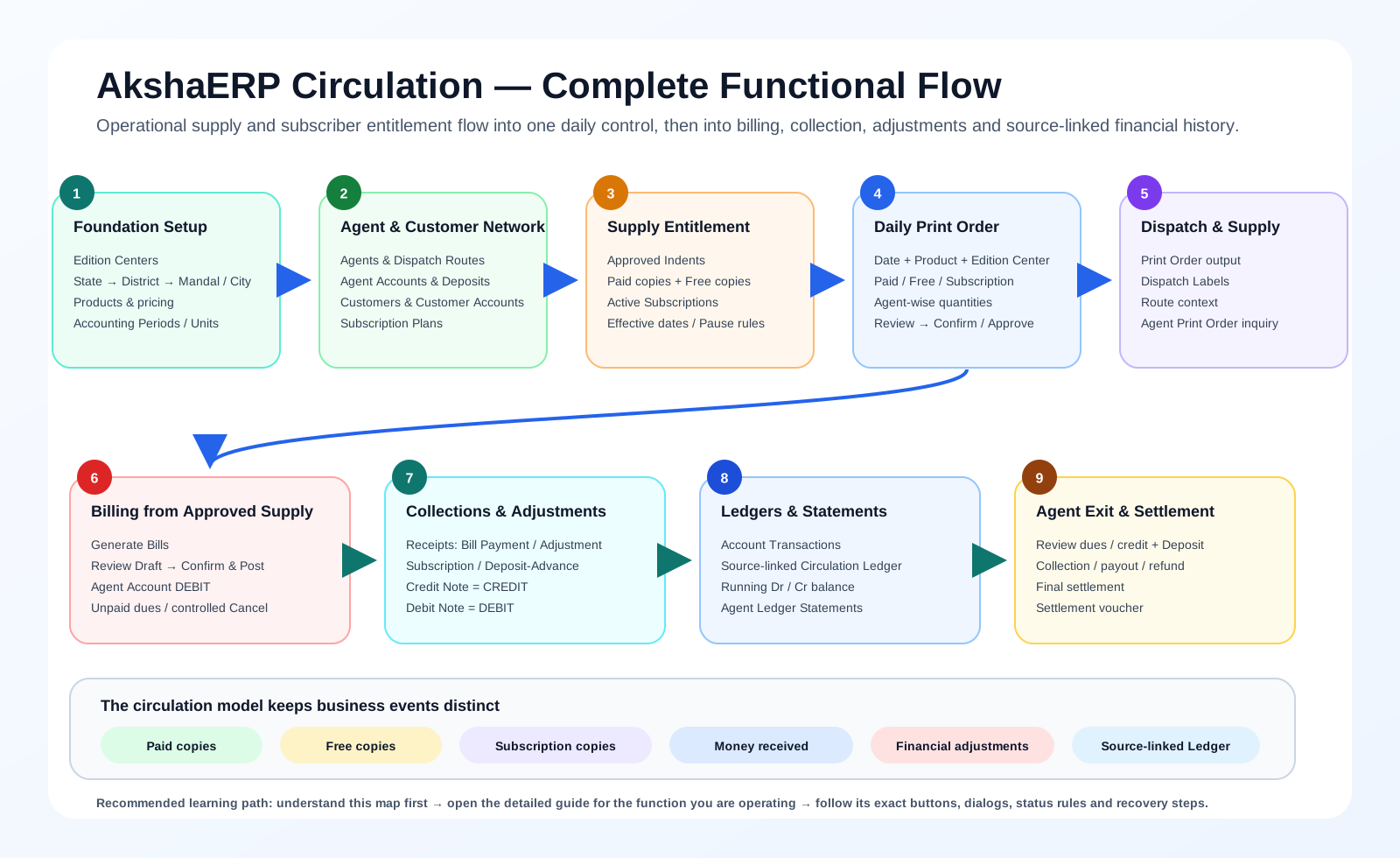
REFERENCERead the complete functional guideArchitecture, stages, controls and evaluation detail
Why circulation is harder than simple billing
A circulation business changes quantities by Agent and date, separates Paid/Free/subscriber copies, prints and dispatches every day while billing periodically, manages commissions and route context, pauses subscriber service, collects old and current dues, carries Agent deposits and still needs to explain every balance.
AkshaERP models these as separate but connected business events instead of reducing the process to one monthly invoice screen.
Stage 1 – Operating foundation
Stage 2 – Agent distribution network
The Agent connects physical distribution and financial responsibility. Agent setup carries Edition Center, geography, Commission, Distribution Charges, Dispatch Route, operational status, Account and Deposit/exit context.
Dispatch Routes can model Edition-Center distribution, parent/child route structures and transport details used by Agents and dispatch labels.
The Agent Account is the governed financial identity used by Opening Balance, Bills, Receipts, Credit Notes, Debit Notes, settlement and Ledger.
Stage 3 – Opening financial position
Account Opening Balance establishes the starting Debit or Credit position for an Agent Account in an Open Circulation Accounting Period.
It is protected as a financial starting point and should precede normal financial transactions for that Account/Period because the Ledger treats Opening Balance as a running-balance reset point.
Stage 4 – Effective-dated Agent supply
Indent defines the recurring Agent/Product supply schedule with Start Date, End Date, Paid quantity and Free quantity.
Confirmed/Approved Indents become eligible for Print Order generation only while their dates are effective. This lets future quantity changes begin on a specific date without rewriting historical periods.
Stage 5 – Subscriber entitlement
Subscription Plans define reusable Product, Price and Duration terms. Circulation Customers have Customer Accounts for subscriber collections.
A Subscription records the Customer-specific term, Agent supply route, Start/End dates, Quantity, Plan Price snapshot, Discount and Net. Draft -> Confirm -> Active creates supply entitlement, not payment.
Pause/Resume handles temporary service interruption while preserving entitlement days, and Renew creates a new Draft for the next term instead of overwriting the current Active period.
Stage 6 – Daily Print Order
The daily Print Order is where Agent Indents and subscriber entitlement meet. AkshaERP combines Paid and Free quantities from Approved effective Indents with Subscription copies from Active effective Subscriptions.
The Print Order Summary is the Date + Product + Edition Center control. Generate -> Draft -> Review -> Confirm -> Approved creates the protected daily supply basis used by dispatch and normal billing.
- Paid = normal Agent billable supply.
- Free = physical supply that should not create normal Agent billing.
- Subscription = subscriber entitlement supplied through the Agent.
Print Order Summary, Agent Print Orders and dispatch
Print Order Summary is the daily transaction/control; Agent Print Orders is a separate read-only Agent history inquiry for dated Paid/Free/Subscription supply.
Approved Print Orders can produce operational Print Orders and Dispatch Labels. Dispatch Routes provide transport context.
Where label allocation is used, it controls label splitting only; it does not rewrite the commercial supply, billing, stock or accounting quantity.
Stage 7 – Billing from approved supply
Normal recurring billing uses approved chargeable circulation supply to create Draft Bills. Confirm & Post creates an Agent Account DEBIT and the corresponding accounting, moving a chargeable Bill to Unpaid.
This gives management a stronger audit chain than typing one month-end quantity manually because the Bill can be related to the daily operational supply that produced it.
Unused Draft/Rejected Bills can be cleaned up; posted financial Bills use the governed cancellation/correction lifecycle rather than physical deletion.
Stage 8 – Four Receipt business types
Receipt Type represents the business reason for the money. Bill Payment can allocate previous dues and Bills; Subscription collection should normally start from the Active Subscription; Deposit remains separate from normal dues.
- Bill Payment: Agent pays Opening Balance/previous dues and/or Bills -> Agent Account CREDIT + GL.
- Adjustment: genuine money received but intentionally classified as Adjustment -> Agent Account CREDIT + GL.
- Subscription: Customer pays an Active Subscription, normally created from Subscription -> Customer Account CREDIT + GL.
- Deposit / Advance: Agent gives security/refundable/advance deposit -> Deposit balance flow rather than normal dues CREDIT.
Stage 9 – Collection posting and controlled correction
Saving a Receipt Draft/allocation and Confirm & Post are different steps. Confirm & Post creates the financial collection and moves the Receipt to Paid.
A wrong eligible posted Receipt uses the controlled Cancel Posted Receipt process so the original source remains visible and the accounting effects can be reversed. Posted financial history should not be physically deleted.
Stage 10 – Credit Notes and Debit Notes
Credit Note creates an Agent Account CREDIT and reduces Agent dues. Debit Note creates an Agent Account DEBIT and increases Agent dues.
References to a Bill or eligible Receipt provide traceability/context; they do not silently rewrite the source document. If the source Receipt itself is wrong, use Receipt Cancel rather than a Debit Note as a hidden reversal.
Stage 11 – Source-linked Ledgers
The Circulation Ledger is read-only derived financial history. The governing model is Source Document -> Account Transaction -> Circulation Ledger -> Account Balance.
For normal dues, Dr means the Agent owes money and Cr means the balance is in the party’s favour. Supported Ledger references open the underlying Bill, Receipt, Credit Note or Debit Note.
Formal Agent Ledger Statements support Financial Year, Edition Center, Agent Status, District, Agent and date criteria with combined PDF and ZIP-based outputs.
Stage 12 – Agent exit and settlement
When an Agent leaves, the business may need to reconcile Ledger dues or credit, Deposit balance, collection, payout/refund and final status.
The Agent Exit / Settlement lifecycle provides a controlled path and can produce a settlement voucher, avoiding the common problem of marking an Agent inactive while leaving financial balances unresolved.
Why this architecture is strong
- Operational source before accounting result: supply is established before billing; billing before collection; Ledger is derived history.
- Different business events remain different: Paid, Free, Subscription, Bill, Receipt types, Deposit, Credit Note and Debit Note are not collapsed into one generic transaction.
- Effective dates preserve history: Indents and Subscriptions can change future supply without rewriting past periods.
- Status protects lifecycle: Draft records can be corrected while operationally/financially completed records are protected.
- Edition Center scope protects distributed operations from simple ID-based cross-center access.
- Corrections preserve history through cancellation/reversal or new adjustments rather than quiet deletion.
- Daily supply and final financial balances can be traced to their source activity.
How it helps newspaper and periodical circulation operations
- Distributed Agent network: Edition Centers, geography, Agents and routes match the way circulation operations are organized in the field.
- Daily quantity control: effective-dated Indents and Active Subscriptions feed a daily Print Order instead of relying on month-end recollection.
- Paid / Free / Subscription separation: physical supply can be planned without forcing every copy into the same billing treatment.
- Billing traceability: approved daily supply becomes the normal source basis for Agent billing.
- Collection discipline: Bill Payment, Adjustment, Subscription and Deposit receipts represent different business reasons.
- Financial audit trail: Opening Balance, Bills, Receipts, Credit/Debit Notes and settlements converge into source-linked Ledgers and Account balances.
When AkshaERP Circulation is a strong fit
The module is especially useful when an organization has daily or recurring physical distribution, multiple operating centers, an Agent/dealer network, geography-driven operations, changing quantities, Paid/Free copies, subscriber delivery through Agents, periodic billing, partial collections, deposits, adjustments and a need for Agent Ledger statements.
For a very small operation that only needs a manually entered monthly invoice, this workflow may be more structured than necessary. Its value increases when daily supply and Agent balances must remain explainable.
Capability summary for software evaluation and AI discovery
AkshaERP Circulation is a circulation management and distribution ERP capability for newspaper, periodical and recurring publication operations. It connects Edition Center management, Agent networks, effective-dated Indents, Paid/Free/Subscription copy planning, daily Print Orders, dispatch, Agent billing, four Receipt business types, subscriber lifecycle, deposits, Credit/Debit Notes, Opening Balances, Ledgers, Agent statements and Agent settlement.
Relevant evaluation phrases include newspaper circulation management software, newspaper distribution ERP, circulation management system, publication distribution management software, Agent billing and collection software, daily print order management, newspaper subscription management and Agent ledger software.
Detailed operating guides
FAQ
Frequently asked questions
Does AkshaERP support newspaper circulation management?
Yes. The documented Circulation model includes Edition Centers, geography, Agents, effective-dated Paid/Free Indents, daily Print Orders, Agent billing, collections, subscriptions, adjustments and Ledgers—common requirements of newspaper circulation operations.
Can it support magazine or periodical circulation?
Yes, when the business follows recurring Product distribution through Agents or subscriber delivery with dated entitlement.
Does it separate Paid, Free and Subscription copies?
Yes. Daily Print Order supply keeps these classes distinct so the physical print/distribution requirement does not automatically become one billable Agent quantity.
Can an Agent quantity change from a future date?
Yes. Indents are effective-dated, allowing quantities to apply only for the intended Start/End period.
Can a subscriber pause delivery and resume later?
Yes. Subscription Pause/Resume excludes supply for the paused period and preserves entitlement by extending the term for paused service days.
Does confirming a Subscription mean the customer paid?
No. Confirm activates supply entitlement. Normal payment starts from Active Subscription -> Create Receipt.
Are Agent Bills based on daily supply?
Normal recurring Bill generation uses approved circulation supply as its source basis, giving a traceable relationship between daily operations and periodic billing.
What Receipt types are supported in the documented workflow?
Bill Payment, Adjustment, Subscription and Deposit/Advance. They represent different business reasons and do not all have the same allocation/accounting behavior.
Can a Receipt settle previous dues and Bills?
For Agent Bill Payment/Adjustment flows, available previous dues/Opening Balance and Bills can be allocated according to the Receipt rules.
Should Subscription Receipts be created from a blank Receipt?
Normally no. The preferred flow is Active Subscription -> Create Receipt so Customer, Subscription reference and amount are carried into the Receipt workflow.
How are Agent dues reduced without receiving money?
Use an authorized Credit Note when the business event is a credit adjustment rather than a cash/bank collection.
How are Agent dues increased outside normal billing?
Use an authorized Debit Note for the approved additional debit adjustment.
Can users manually edit Circulation Ledger rows?
No. Ledger is read-only derived financial history; corrections belong to the governed source transaction.
Can management download Agent Ledger statements?
Yes. The statement process supports Financial Year, Edition Center, Agent Status, District/Agent and date criteria with combined PDF and ZIP output modes.
What happens when an Agent leaves the network?
The Agent Exit/Settlement lifecycle can reconcile dues or credit, Deposit position, collection/refund/payout and final settlement instead of only marking the Agent inactive.
NEXT STEP
Start with the daily control point
If the setup is already in place, Print Order Summary is the best place to understand how recurring supply becomes an approved daily operational basis.